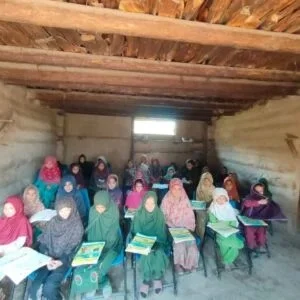
How a Community School in Gilgit-Baltistan Reached 145 Students
In the mountainous region of Gilgit-Baltistan, many children grow up in communities where access to formal education remains limited. Schools are often far away, and families living in remote valleys face constant challenges in sending their children to learn. This is where community school development in Pakistan becomes essential in bridging the gap between children and education. In the Jagir Basin of Gilgit-Baltistan, one couple chose to take this responsibility into their own hands and change the future of the children around them.
Raja Naveed and Maria Bano always believed that education could transform lives. Living among the Gujjar community, they saw how many children were growing up without access to quality education. Due to the lack of educational facilities, many young boys and girls were unable to continue their studies. For Raja and Maria, this was not something they could ignore.
Motivated by their passion for teaching and community development, the couple decided to take the first step themselves. In 2019, they began teaching a small group of children in an open field in the Jagir Basin. At the beginning, there were only a few students and very limited resources. There were no classrooms, no furniture, and no proper learning facilities. But what they had was determination.
Starting a school in a remote area comes with many challenges. Convincing families to send their children to study was one of the biggest hurdles. Many parents were unsure about the benefits of education.
Raja and Maria understood that building trust within the community would take time. They began speaking with parents and explained the importance of education and how it could help their children build a better future. Slowly, families started to support the idea and encouraged their children to attend the classes.
As more students joined, the small initiative began to grow. The couple continued teaching despite the lack of facilities, using whatever resources were available to create a learning environment for their students.
Maria, who holds an Associate Degree in Education, played a key role in shaping the academic structure of the school. Her knowledge and dedication helped the students receive quality instruction even in a modest setting.
“Parent-teacher interaction plays a significant role in the learning process of students. We try to give individual attention to those who do not have literate elders at home to help them with homework and assessments. We believe long-lasting change can only be brought about if the parents, community, and teachers are involved in the progress of the students.”
Says Maria.
Over time, the school became an important part of the community. Parents began to see the positive impact of education on their children, and their support for the initiative grew stronger.
What started with just a few children learning in an open space gradually evolved into a structured learning environment. With continued effort and the support of the community, the school eventually moved into a proper building that included separate restrooms for boys and girls and improved learning facilities. Today, the school serves 145 students, providing children in the region with access to education that was previously unavailable.
As the initiative expanded, Moawin Foundation stepped in to support the school by providing essential facilities, including a proper building. This support helped strengthen the school’s ability to continue serving children. It also ensured that students could learn in a safer and more structured environment. The partnership also reinforced the importance of community-driven education initiatives, where local efforts are strengthened through institutional support.
For Maria, the school remains more than just a workplace; it represents a dream she helped bring to life. While she hopes to continue her own education in the future, she is deeply committed to the school and the students who depend on it.
For Raja and Maria, success is not measured by numbers alone. Their goal has always been simple: to create opportunities for children who might otherwise never have had the chance to study. They believe that even if only a few of their students continue their education and build better futures, their efforts will have been worthwhile.
The journey of Raja Naveed and Maria Bano shows how community school development in Pakistan can begin with a single idea and grow into something that transforms lives.
Their work demonstrates that meaningful change often starts at the local level. Today, the school in Jagir Basin stands as a reminder that education can grow even in the most unlikely places when people are willing to work together to make it possible.