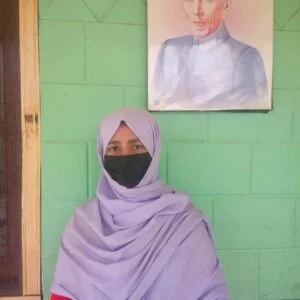
In the remote mountainous region of Gilgit-Baltistan, access to education is often shaped by distance, terrain, and limited school facilities. For many children, continuing education beyond the early years becomes a daily struggle. Shahnaz’s journey reflects what it means to pursue education despite these challenges and how the right support can bring meaningful change.
Shahnaz grew up in Ranga, a small village surrounded by mountains, where basic facilities are limited. She began her early education in an Urdu-medium school in her area. The school had minimal resources, but she remained committed to her studies. Her family of twelve depended on her father, who worked on a daily wage. During the winter, even that income became uncertain. Despite these hardships, Shahnaz continued to dream of getting an education and building a better future.
As she completed her primary classes, a new challenge emerged. The nearest school offering middle-level education was far from her home. Every day, she had to walk nearly two hours to reach school and another two hours to return. The journey was long, tiring, and often difficult due to harsh weather and rough paths. Shahnaz recalls.
“I used to spend hours walking every day just to go to school. There were days when I felt very tired, but I didn’t want to leave my education.”
Over time, these challenges began to create uncertainty. Continuing her education under such conditions was not easy. Yet, she held on to her determination and kept moving forward, hoping for a better opportunity.
That turning point came in February 2020, when Moawin Foundation adopted Baab-ul-Ilm Public School in her community. The school was upgraded to the secondary level, making it possible for students like Shahnaz to continue their education closer to home. Along with this, the Foundation provided free education, stationery, and trained teachers, significantly improving both access and quality of learning.
“When our school was upgraded, I felt like my dreams were finally within reach”.
She says.
With a school now available in her own community, Shahnaz no longer had to walk long distances every day. The time and energy she once spent on travel could now be focused on her studies. The presence of trained teachers and a better learning environment helped her understand her lessons more clearly and stay consistent in her education. Shahnaz shares.
“I feel more confident now, I can study peacefully and focus on my future. I want to continue my studies and make my family proud.”
For Shahnaz and many other students in her village, this change meant more than just convenience. It meant continuity in education, renewed confidence, and a stronger sense of possibility. Families who once struggled to send their children to distant schools could now see them learning within their own community.
Shahnaz’s story reflects how improving school access and strengthening education systems in remote areas of Pakistan can transform lives. What once seemed like a difficult and uncertain journey has now become a path filled with hope.
Today, she continues her education with determination and a clear sense of purpose. Her journey is a reminder that when education is brought closer to communities, it opens doors, builds confidence, and creates opportunities for a better future.